
Living Landscapes and Resilience Program
Restoring streambanks, improving soil health and controlling invasive weeds to build landscape resilience in the Laidley Creek sub-catchment
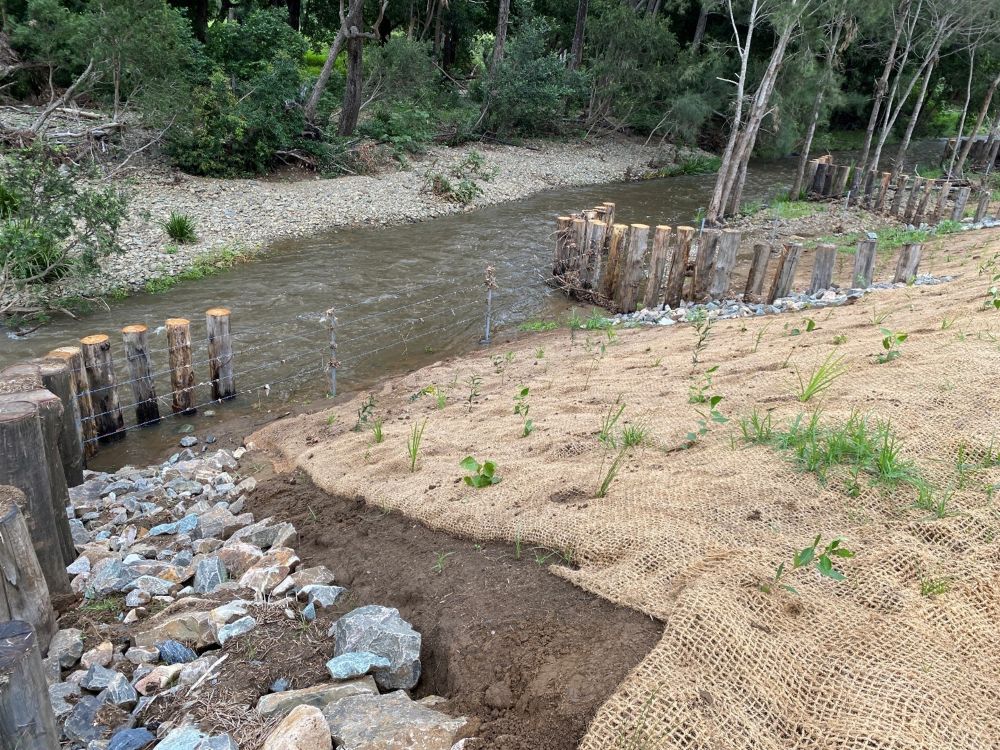
 Example of similar project addressing water quality, soil health, and land condition through engineering nature-based solutions by Healthy Land & Water.
The Living Landscapes & Resilience Program targets streambank restoration to increase flood resilience, safeguard productive agricultural land and support the regeneration of native vegetation within the Laidley Creek sub-catchment and surrounding areas. This integrated approach addresses water quality, soil health, and land condition through engineering solutions, improved agricultural practices, and invasive species management across the catchment.
What we are doing
- 1.25 kilometres of streambank remediation within the Laidley Creek sub-catchment through a combination of large-scale engineering solutions, revegetation, gully remediation, assisted regeneration, riparian fencing, and nature-based solutions to improve streambank and riparian condition.
- Improve soil health and condition across 400 hectares through individual soil testing, one-on-one engagement with landholders, agronomist advice, and implementation of improved agricultural practices on grazing and horticultural properties.
- Improve land condition across 50 hectares through threat abatement activities, including best practice management of invasive weeds, off-stream watering infrastructure, and stock fencing.
- Develop and implement comprehensive monitoring programs using the State-wide indicator framework (SWIF) tools, including StreamBankCAT, SoilCAT, and LCAT, to measure baseline conditions and track progress toward restoration and improvement targets.
Measuring success  Example of similar project addressing erosion and revegetation by Healthy Land & Water.
This project will deliver:
Improved streambank and riparian condition along 1.25 kilometres of waterways through engineering works, revegetation, and assisted regeneration.
Enhanced soil health and condition across 400 hectares on approximately 40 grazing and horticultural properties through soil testing, agronomist guidance, and implementation of improved agricultural practices.
Improved land condition across 50 hectares through integrated weed control, off-stream watering infrastructure, and stock fencing.
Increased flood resilience and reduced erosion through streambank stabilisation and riparian restoration.
On-ground actions:
- Large-scale streambank engineering works including earthworks, rock armouring, and erosion control structures.
- Small-scale streambank restoration including riparian fencing, bioengineering, targeted revegetation, and weed control.
- Soil health workshops, testing programs, and agronomist consultations with landholders.
- Implementation of improved agricultural practices based on soil test results.
- Integrated weed management and invasive species control.
- Installation of off-stream watering points and stock exclusion fencing.
Why this project is important
|
The Laidley Creek sub-catchment is a key watershed in the Lockyer Valley, supporting agricultural production and ecological values. However, the catchment faces significant challenges, including streambank erosion, declining soil health, and invasive weed infestations that threaten both productive agricultural land and aquatic ecosystems. Streambank erosion along Laidley Creek and its tributaries contributes to poor water quality, loss of productive land, and reduced flood resilience. Degraded soil health impacts agricultural productivity and limits the landscape's ability to resist and recover from droughts, floods, and other climate-related challenges. Invasive weeds further degrade land condition and compete with native vegetation. This integrated project addresses multiple pressures simultaneously, delivering benefits for water quality, agricultural productivity, biodiversity, and landscape resilience. By working directly with landholders and combining engineering solutions with nature-based approaches, the project builds long-term capacity for sustainable land and water management in the catchment. |
Project snapshot
| Project name: | Living Landscapes and Resilience (2025-2028) |
| Project manager: | Leonard Ainsworth, Healthy Land & Water |
| Catchment: | Laidley Creek, Lockyer Valley |
| Funders/Partnerships: |
This project is funded by the Queensland Government’s Natural Resource Management Expansion Program. The project is delivered by Healthy Land & Water in partnership with South-East Queensland local governments, community groups, and private landholders, and aligns with the NRM Expansion Program Logic & Indicators Framework, NRM Regions QLD Plan 2024-2028, SEQ Natural Resource Management Plan 2021–2041, Queensland Biodiversity Conservation Strategy, Queensland Climate Adaptation Strategy, Queensland Matters of State Environmental Significance (MSES), Shaping SEQ 2023, and local council environmental objectives. |
Project collaborators
This project is funded by the Queensland Government’s Natural Resource Management Expansion Program.

The project is delivered by Healthy Land & Water in partnership with South-East Queensland local governments, community groups, and private landholders, and aligns with the NRM Expansion Program Logic & Indicators Framework, NRM Regions QLD Plan 2024-2028, SEQ Natural Resource Management Plan 2021–2041, Queensland Biodiversity Conservation Strategy, Queensland Climate Adaptation Strategy, Queensland Matters of State Environmental Significance (MSES), Shaping SEQ 2023, and local council environmental objectives.

Level 11, 240 Queen St, GPO Box 735
Meanjin (Brisbane) QLD 4001, Australia
Monday - Friday 8.30am - 5.00pm
Healthy Land & Water Ltd ABN 91 115 662 989
About Us
What's on
Our Impact
Contact us
Phone: (07) 3177 9100
Email: info@hlw.org.au
We acknowledge that the place we now live has been nurtured by the Traditional Custodians of this Country for tens of thousands of years, and that their physical, cultural and spiritual custodianship of our land, water and skies is ongoing.

